
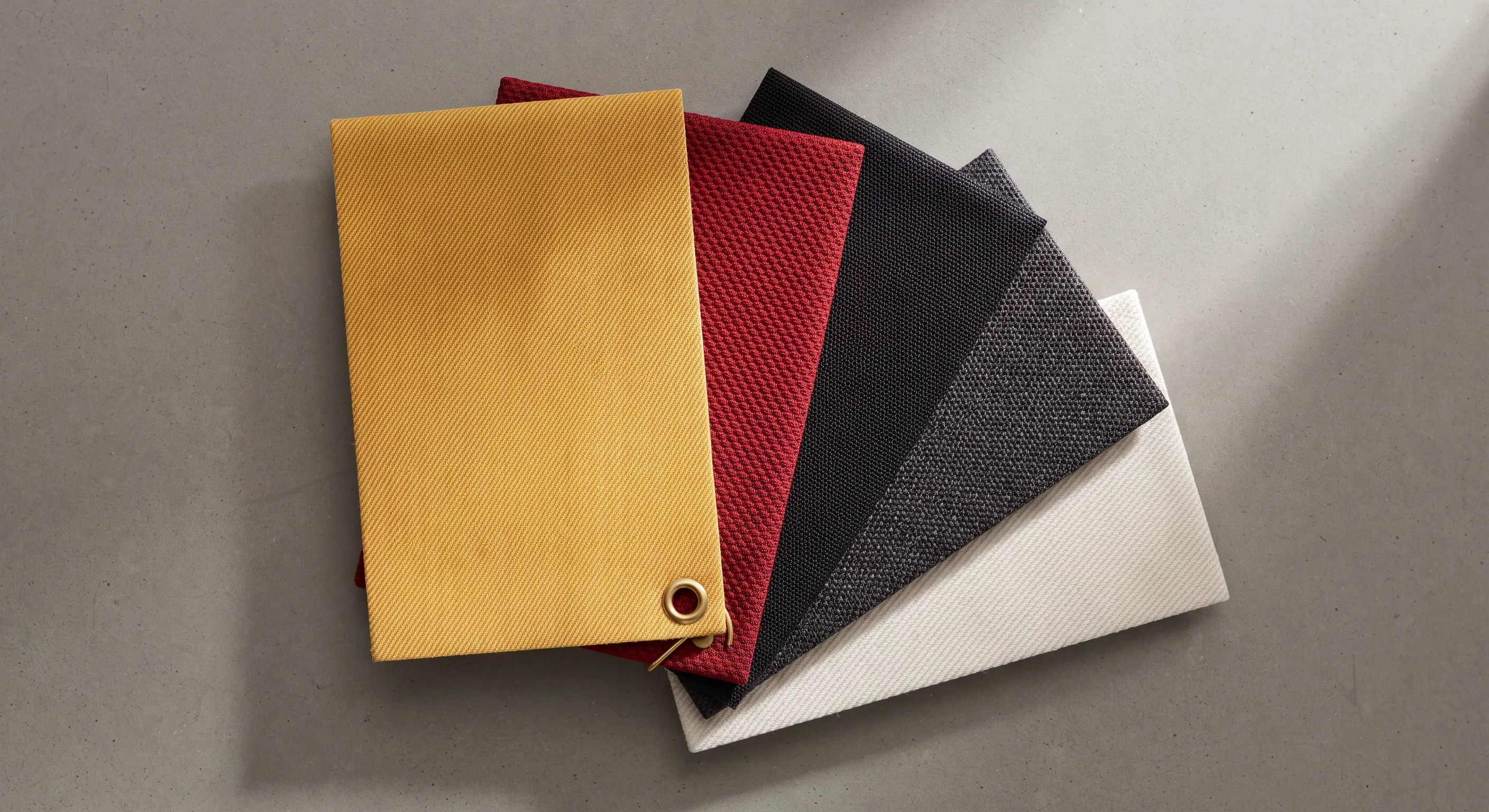
A lab dip, not a screenshot.
Colour is where most uniform contracts go wrong, and it almost always goes wrong the same way: everyone agreed on an image, nobody agreed on a physical sample.
-
You choose a direction
From this card, a Pantone reference, or a garment you already have. Any of the three works as a starting point.
-
We dye a lab dip
Small pieces of your actual fabric, dyed in two or three variations around the target. Colour behaves differently on twill than on knit, so it is dyed on the cloth you are ordering.
-
You approve one physically
The swatches are couriered to you. You pick one, sign it, and send it back. That signed piece becomes the standard.
-
It stays on file
Every future run is matched against that physical piece under controlled light, not against a screen or a memory. This is why a reorder in year three still matches.
No monitor or phone is. Brightness, colour profile and ambient light all shift what you are looking at, and fabric texture changes it again. Treat every swatch on this page as an indication of the family, never as the final decision.
Stock shades, ready to dye.
These are on file and can go into production without a new lab dip cycle, which saves about a week. Anything outside them is matched to your reference.
Three ways to give us a colour.
If your brand shade is not on the card, any one of these is enough to start. The physical sample is always the best of the three.
A physical sample
A garment, a swatch, a printed brand guide, even a painted panel. Post it to us and we match the dye to the object under controlled light. This gets closest, every time.
A Pantone reference
TCX for textile is ideal, TPG or C works too. Tell us which system it is, because the same number in two systems is two different colours and that mistake is common.
A hex or CMYK value
Screen and print values were never made for dye, so we treat them as a direction rather than a target. We will send lab dips around it and let you pick the closest.
Not every shade survives every laundry cycle.
Colour fastness is tested before bulk on every programme. These are the general ratings by family, on a scale where 5 is best.
| Colour family | Wash | Light | Rubbing | Notes |
|---|---|---|---|---|
| Navy and black | 4 to 5 | 4 to 5 | 4 | Most stable family. Can crock onto light fabrics when new, so wash separately once. |
| Greys and neutrals | 4 to 5 | 4 to 5 | 4 to 5 | Very stable. Pale greys show soiling before they show fading. |
| Blues and teals | 4 | 4 | 4 | Reliable. Bright royal shades soften slightly over the first few washes then hold. |
| Greens | 4 | 4 | 4 | Surgical green is built for repeated high temperature laundry. |
| Reds and burgundy | 3 to 4 | 3 to 4 | 3 to 4 | The family to watch. Deep reds hold better than bright reds, and both need a controlled dye and a separate first wash. |
| Earth tones | 4 | 4 | 4 | Forgiving in service. Hides site marks better than any other family. |
| Hi-vis and brights | 4 | 3 to 4 | 4 | Fluorescents fade with UV exposure by design. Certified hi-vis has a stated service life, plan replacements around it. |